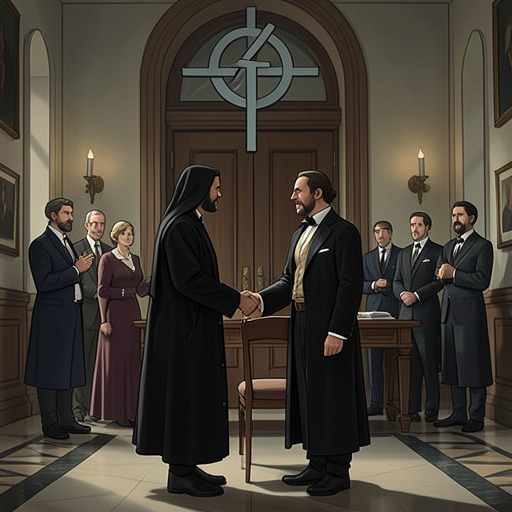
Choice-Based Social Reform
The Vampire Prince’s BrideChoice-Based Social Reform is the political and ethical program advanced by Maskin and ultimately embraced by Cheryl and Bjorn. It challenges a Temadian order that assigns people their social rank, labor, marriages, and political roles from birth, replacing inherited obedience with education, consent, and the right to choose. Its decisive test is not an abstract debate: it becomes the principle by which Cheryl claims authority over her own life and by which Maskin, a slave, is recognized as a legitimate king alongside Bjorn.
Definition and Social Background
Choice-Based Social Reform arises from a society whose institutions preserve rules formed in the age of light speed travel. Maskin explains that he was taken from his family at birth and raised by machines to become “a machine himself,” deliberately denied independent thought, goals, and dreams. Cheryl’s position appears more privileged, since she was raised to be queen and protected from ordinary labor, yet Maskin identifies the same underlying coercion in her life: she was prepared to be handed to a man without having any choice of her own. The system therefore produces different forms of bondage for slave and royal alike. One person is trained to serve; the other is trained to submit gracefully to a prescribed political and marital destiny.
The reform’s central claim is that status does not create moral fitness. Maskin argues that an empire built on people whose backs can break is precarious, especially when slaves are educating themselves and unrest is growing toward civil war. He rejects the assumption that only an established noble or pampered prince can rule, contrasting his own service during the Apdratee invasion with Bjorn’s life of being waited on. His question is political as well as personal: if a pampered boy such as Bjorn can become king, then a slave who helped save the world should not be disqualified by birth.
Choice, Consent, and Education
The reform treats the ability to choose as a capacity that society must teach rather than a privilege that society may withhold. Cheryl admits that she cannot even choose between two men because she has never been trained to direct her own life. Maskin answers that this uncertainty is precisely evidence for reform. People should be taught to choose, whether their decisions prove wise or poor, instead of having their lives dictated by the authorities seated in the sapphire chairs. Choice is therefore not presented as guaranteed success. It is presented as the condition of adulthood, responsibility, and political legitimacy.
The principle also changes the meaning of royal marriage. Quincy insists that the queen does not choose her king, preserving the old arrangement in which a priest or ruling institution determines the woman’s fate. Bjorn directly contests that rule by proposing that Cheryl choose two kings rather than accept the tradition that requires one of them to die. He frames the arrangement as the beginning of a new era, asking whether the Gods truly demanded a death or whether that conclusion came only from a priest. His intervention joins romantic consent to constitutional change: Cheryl’s freedom to choose her partners becomes evidence that the wider society can abandon compulsory roles.
Political Conflict and Institutional Resistance
The reform meets resistance from the people who benefit from obedience being mistaken for order. Quincy calls Maskin a slave and declares that his duty is to bow to a superior’s will. His language makes hierarchy sound like law and submission like virtue. He also treats Cheryl’s human identity as grounds for exclusion, demanding that she and Bjorn be killed because their alliance allegedly threatens the world and would leave Temadian resources vulnerable to the Apdratee people. The threat is thus cast in both class and species terms: the established order presents free choice as treason, contamination, and national danger.
Bjorn answers by redefining loyalty. The warriors had been ordered to kill Maskin, but Bjorn argues that their first loyalty belongs to the crown, which now rests solely with Cheryl. If the queen has no choice in the matter, he asks, can the warriors honestly deliver her to a man selected by someone else? The argument shifts the warriors’ allegiance away from the houses and toward the sovereign’s consent. Their swords lower when they recognize Maskin as the Hero of the Apdratee Invasion and imagine a new political arrangement: a slave and a prince serving as kings, with a queen who chooses both.
Cheryl’s declaration gives the reform its most important public articulation. Standing beside Bjorn and taking his hand, she identifies the fear at the center of the old system: rulers fear strong people because they do not want them to know their own strength. They resist choice because people who understand their strength may refuse to choose those rulers. In this formulation, coercion depends not only on force but on cultivated ignorance. Education becomes politically dangerous because it reveals that obedience was imposed rather than natural.
Founding a New Political Order
Maskin initially worries that his argument has frightened Cheryl and considers whether he should simply demand her. That hesitation exposes the danger within the reform itself: a movement founded on freedom can reproduce domination if its advocates replace one command with another. The narrative places his desire beside his stated principles and leaves the conflict visible rather than treating liberation as automatically pure. Cheryl must be persuaded, not possessed, if the new order is to mean anything.
Bjorn’s promise to find a way for the three of them to remain together converts the reform from an argument into a collective political project. He physically joins Cheryl and Maskin, holding one while gripping the other, and pledges to use all his power to secure their union. The gesture makes partnership a visible alternative to rivalry and sacrifice. Instead of allowing tradition to decide which man survives and which man is removed, the proposed order preserves all three participants through a choice made by Cheryl.
The decisive turn comes when Cheryl acknowledges that she once believed she had no control over her life or fate, then affirms that everyone possesses that choice. Her claim is both personal revelation and constitutional principle. It authorizes her to choose, legitimizes the warriors’ refusal to obey Quincy’s command, and permits Maskin’s status to be reconsidered. The warriors’ swords turn toward Quincy, showing that the reform has moved from private conversation into collective enforcement.
Thematic Significance and Consequences
Choice-Based Social Reform joins emancipation, gender autonomy, and political succession into one structure. Maskin’s experience demonstrates how slavery strips a person of family, education, imagination, and future-directed desire. Cheryl’s experience demonstrates that luxury does not cancel coercion when a woman is denied authority over marriage and destiny. Bjorn’s position reveals that inherited privilege can also be challenged from within the royal order when he rejects the assumption that tradition must decide which relationship and which ruler are permissible.
The reform’s implied social transformation is therefore broader than the appointment of new kings. It contests the Temadian slave system, the temple’s authority over royal marriage, the separation between noble worth and slave birth, and the belief that stability requires people to remain docile. It also changes the meaning of strength. Strength no longer belongs exclusively to priests, houses, or hereditary rulers; it belongs to people who can understand their own power and exercise judgment. In that sense, the reform seeks to preserve society not by freezing its hierarchy, but by preventing a brittle empire from collapsing under the weight of its own coerced population.
Its immediate outcome is a refusal to kill Maskin for being a slave and a public recognition that Cheryl may choose both Maskin and Bjorn. Its deeper consequence is the possibility of a new era in which political legitimacy comes from consent rather than assignment. The reform remains difficult and frightening because it asks people trained to fear disorder to accept uncertainty, error, and shared authority. Yet the scene presents that uncertainty as the price of genuine freedom: a life chosen badly still belongs to the chooser, while a life dictated by others is a form of slavery even when it is wrapped in royal privilege.